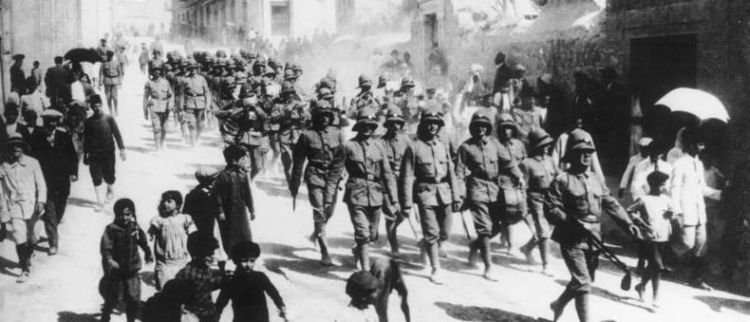
During the Great War the focus of attention for British,
French, Belgian and American observers was the Western Front in France and Flanders. However the western Allies also fought the
Central Powers in significant campaigns in Africa, Italy,
Greece, Turkey, Palestine
and Mesopotamia. These other fronts became known in Britain
as “Sideshows”.
For a time Serbia and Roumania fought on behalf of the
Allied cause in Europe whilst Russia engaged in large-scale battles against the
Austro-Hungarians and Turks on the Eastern European Front and in the Caucasus
Mountains. Meanwhile the Allies invaded
German colonies in China and
the Pacific Ocean and British troops defended Aden
against Turkish attacks from Yemen.
Although the British War Office became exasperated by the
demands made by the Sideshows the Germans took the opposite view. Germany wanted to see Allied
strength dissipated away from the Western Front. The Germans allocated funds and manpower to
intrigues stretching from Libya
to India. By using their ally Turkey, a Jihad or Muslim Holy War was
instigated by the Germans from Constantinople
against the Allies.
Germany attempted to bring both Afghanistan and Persia
into the war so that India could be invaded; Indian dissidents were patronised
by the Germans and boatloads of arms and ammunition were despatched towards
India to assist planned rebel uprisings.Abyssinia was also approached and offered
Italian Eritrea if it would ally itself with Germany
- the German motive here was to use
Abyssinian territory and Turkish troops to invade Sudan
and then Uganda to support
the German force fighting in East Africa.
In the Gulf region German agents were particularly
successful in encouraging local tribes to attack British troops along the
Indian border and in Persia
and Muscat. Britain countered by sponsoring the
Arab Revolt against the Turks in Arabia,
where T.E. Lawrence rose to fame.
When revolution took Russia out of the war Britain fought
the Turks on Russian soil at Baku on the Caspian Sea. After the war the Allies intervened in the
Russian Civil War, fighting the Bolsheviks in North and South Russia, the Baltic and
Transcaspia. In Siberia the Allies intervened and confronted
the Bolsheviks but left the fighting to the Czech Legion (formed by the
Imperial Russian Army from Austro-Hungarian prisoners of war) that was
withdrawing to Vladivostock. In Anatolia
Turkish nationalists fought with Allied occupation troops after the Armistice,
and in Mesopotamia
a post-war Arab revolt involved the British in serious fighting. On the Indian North West Frontier a war was
fought against an Afghan invasion and conflict with tribal insurgents both on
the frontier and in India lasted until the
late 1930s. Elsewhere the British Army
dealt with revolts in Burma
and Palestine.
The military actions in these Sideshows and on these
distant battlefields are not well known but they deserve to be. Courage and esprit-de-corps were not the only
necessary abilities for the warriors of both sides. Often the logistic support, especially
casualty evacuation and treatment, was very rudimentary and supply lines were
long and vulnerable. The ability to
accept hardship for long periods was very necessary. These battlefields required a more
resourceful and innovative type of leadership than did the well-planned,
well-supported and predictable military actions on the Western Front.
So let us look at several of these non-African
battlefields, and at the men who fought and risked death or wounds on
them. Some articles will feature
campaigns prior to World War 1 so that we may follow the development of British
and other nations’ historical interests in various regions of the world before
Great War hostilities commenced.
-- The
Perak War 1875-76 : The award of a Victoria Cross to a Goorkha officer
--
The fight
for Tekrit :
The 8th
Infantry Brigade in Mesopotamia, 5th
November 1917
-- Oranges, Dates & Coconuts: 58th Vaughan’s Rifles (Frontier Force) in Egypt, Palestine,
Somaliland and Portuguese East Africa -- Aden 1916: The
Malay States Guides in action at Hatum, Aden,
12th January 1916
Sarawak 1941 : Japanese Attack on Sarawak in December 1941
and the
fighting
withdrawal of 2/15th Punjab Regiment
-- The Kuki Rising: Insurrection in north-eastern India and Burma 1917-1918
-- Kurdistan 1919 : Military Operations in
Mesopotamian Kurdistan
-- Aden:
Military Operations in Aden during 1914 and 1915
-- Dunsterforce :the maintenance of an
effective force on the Caucasus Front so as to protect the occupied portions of
Turkish Armenia and to prevent the realisation of Pan-Turanian designs.
The intellectual property associated with Harry's Sideshows is owned by
Harry Fecitt MBE TD. Please acknowledge Harry's Sideshows should you
wish to use any of the written material displayed here.








































































































 During the Great War the focus of attention for British,
French, Belgian and American observers was the Western Front in France and Flanders. However the western Allies also fought the
Central Powers in significant campaigns in Africa, Italy,
Greece, Turkey, Palestine
and Mesopotamia. These other fronts became known in Britain
as “Sideshows”.
During the Great War the focus of attention for British,
French, Belgian and American observers was the Western Front in France and Flanders. However the western Allies also fought the
Central Powers in significant campaigns in Africa, Italy,
Greece, Turkey, Palestine
and Mesopotamia. These other fronts became known in Britain
as “Sideshows”.